

What Are Autonomous AI Agents? A Complete Guide for Businesses in 2026
Artificial intelligence has evolved far beyond simple chatbots and rule-based automation. Today, businesses are adopting autonomous AI agents that can plan, make decisions, execute tasks, and improve their performance with minimal human intervention. Instead of simply responding to commands, these intelligent systems can work toward a goal by breaking it into smaller tasks, using connected tools, and adapting based on results.
For organizations, this means faster workflows, lower operational costs, and improved productivity. Whether it’s managing customer support, qualifying sales leads, or automating internal operations, autonomous AI agents are becoming an essential part of digital transformation.
In this guide, you’ll learn what autonomous AI agents are, how they work, their business benefits, real-world use cases, and the challenges organizations should consider before adopting them.
What Are Autonomous AI Agents?
Autonomous AI agents are software systems that can perform tasks independently to achieve a specific objective. Unlike traditional automation tools that follow predefined rules, these agents can understand goals, plan actions, use external applications, and adjust their approach based on new information.
Think of an autonomous AI agent as a digital team member rather than a basic chatbot. Instead of waiting for instructions after every step, it can complete an entire workflow on its own.
For example, if a business wants to automate lead generation, an AI agent can:
- Research potential customers
- Collect relevant business information
- Prioritize qualified leads
- Draft personalized emails
- Schedule follow-up reminders
- Update CRM records automatically
This ability to handle multi-step processes makes AI agents significantly more powerful than conventional automation software.
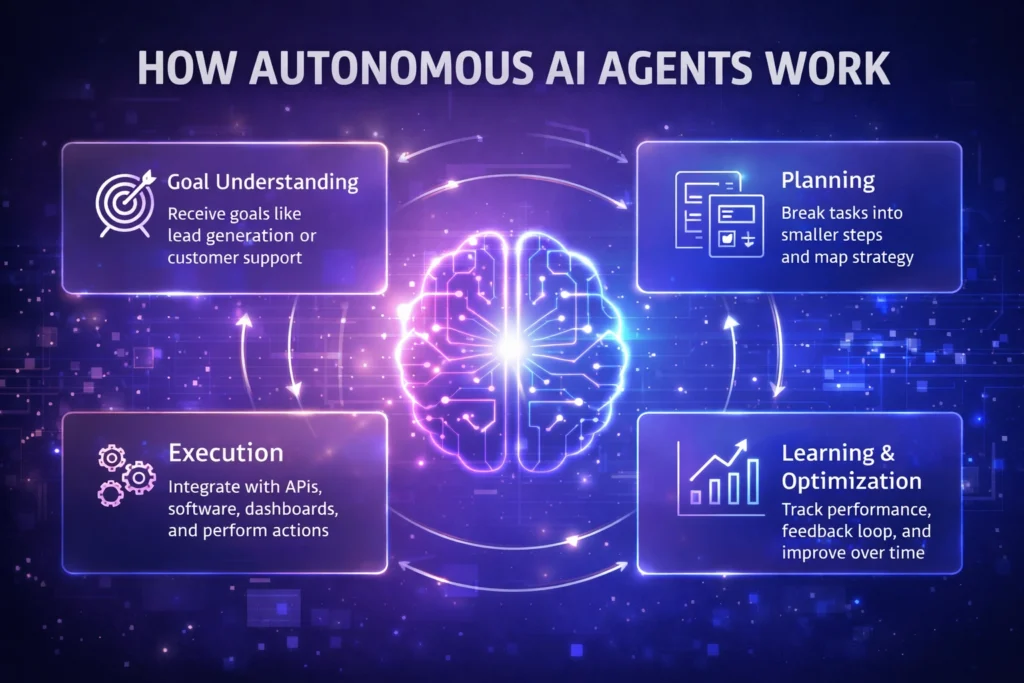
How Do Autonomous AI Agents Work?
Although these systems appear highly intelligent, they generally follow a structured process.
1. Understanding the Goal
The AI agent first receives a business objective, such as improving customer support or automating invoice processing.
2. Planning the Workflow
Instead of acting immediately, it divides the objective into smaller tasks and creates a logical execution plan.
3. Executing Actions
The AI agent interacts with software such as CRM platforms, email systems, databases, or project management tools to complete the required work.
4. Evaluating Results
After completing the task, the system analyzes the outcome and identifies opportunities to improve future performance.
This continuous feedback loop enables autonomous AI agents to become more efficient over time.
Key Benefits of Autonomous AI Agents
Increased Productivity
Employees often spend hours performing repetitive tasks. AI agents automate these activities, allowing teams to focus on strategic work.
Faster Decision-Making
AI agents can process large amounts of data quickly and provide actionable insights, helping organizations respond faster to business opportunities.
Lower Operational Costs
Automating repetitive workflows reduces manual effort and improves overall operational efficiency.
24/7 Availability
Unlike human teams, AI agents can work continuously without breaks, making them ideal for customer support and monitoring tasks.
Better Accuracy
By following consistent workflows and validating information, AI agents help reduce common human errors in repetitive processes.

Real-World Business Use Cases
Customer Support
AI agents can answer common questions, route support tickets, and escalate complex issues to human representatives.
Sales Automation
Businesses use AI agents to qualify leads, send personalized emails, update CRM systems, and schedule meetings.
Marketing
Marketing teams use AI agents to analyze campaign performance, personalize customer communication, and automate repetitive marketing tasks.
Human Resources
Recruitment teams can automate resume screening, interview scheduling, and candidate communication using AI agents.
Finance
Finance departments use AI agents for invoice processing, expense tracking, and report generation.
Challenges of Autonomous AI Agents
While AI agents offer significant advantages, businesses should also consider potential challenges.
- Data privacy and security
- Integration with existing systems
- Human oversight for critical decisions
- Employee training and change management
- Ongoing monitoring and optimization
A successful AI implementation combines intelligent automation with responsible governance.
Best Practices for Successful Implementation
Organizations planning to adopt autonomous AI agents should follow these best practices:
- Start with repetitive, low-risk workflows.
- Define clear business objectives.
- Integrate AI with existing software.
- Monitor performance regularly.
- Keep humans involved in high-impact decisions.
- Continuously optimize workflows based on results.

Conclusion
Autonomous AI agents are transforming the way modern businesses operate by automating repetitive tasks, supporting better decision-making, and improving operational efficiency. Unlike traditional automation tools, these intelligent systems can understand objectives, plan actions, and adapt to changing situations, making them valuable partners in business operations.
As organizations continue investing in AI-driven solutions, autonomous AI agents are expected to play an increasingly important role across customer service, sales, marketing, finance, and internal operations. Businesses that begin adopting AI thoughtfully today will be better prepared to improve productivity, enhance customer experiences, and stay competitive in the years ahead.
Frequently Asked Questions (Faqs)
Q1.What are autonomous AI agents?
Autonomous AI agents are intelligent systems that can perform tasks independently by planning, executing, and learning from actions.
Q2.How are AI agents used in business?
Businesses use autonomous AI agents for customer support, marketing automation, lead generation, and workflow management.
Q3.What industries use autonomous AI agents?
Industries like marketing, healthcare, finance, e-commerce, and customer service widely use autonomous AI agents.
Q4.How can beginners start using autonomous AI tools?
Beginners can start by using AI automation tools, learning workflows, and gradually integrating AI agents into their processes.