
Introduction: AI Is Transforming Business Automation
In 2026, companies are struggling to survive in the rapidly changing digital landscape where success will be determined by efficiency, speed, and accuracy. Traditional automation alone will not suffice; this is where AI-based business automation has begun to come into its own by providing businesses with smarter, more adaptable, and self-learning systems.
Unlike rule-based automation, AI-based automation can understand its input through data, learn from the patterns recognized in the data and improve the accuracy of its decision-making over time. AI business automation is changing how businesses operate and grow in all areas of the business from operations and customer support through marketing and finance.
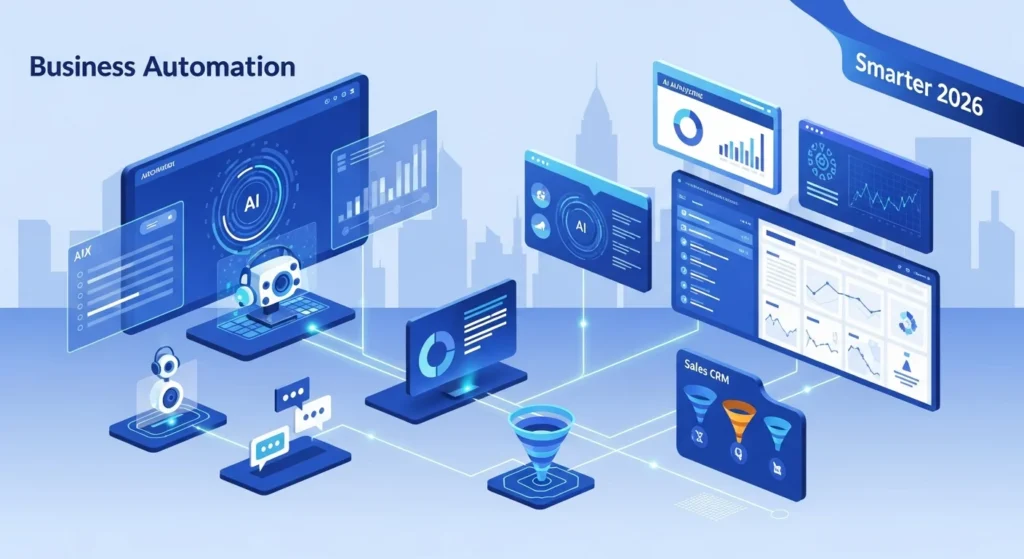
What Is AI Business Automation?
Business Automation with AI refers to the use of AI technologies, including machine learning, NLP and predictive analytics, to transform business workflows into automated processes.
While traditional automation is limited to repeating predefined tasks, AI-enabled automation:
1. Learns from historical and real-time data
2. Adapts to changes in the inputs
3. Predicts outcome and trend
4. Makes decisions based on data
Because of the ability to do these things, intelligent automation is transforming businesses from reactive processes into proactive strategies. By 2026, organizations will no longer use automation solely to automate task but will also use automation to automate the decision-making workflow.
Why Intelligent Automation Is Critical in 2026
The growing importance of AI business automation is driven by multiple factors:
Rapid growth in business data
Increasing demand for personalization
Need for real-time insights
Rising operational costs
Competitive digital marketplaces
Modern customers expect instant responses and personalized experiences. Manual systems cannot keep up with these expectations. AI-powered automation bridges this gap by enabling smarter operations across departments.
Businesses that adopt AI automation gain a competitive advantage by improving speed, accuracy, and scalability.
How AI Is Transforming Business Automation in 2026
1. Smarter Workflow Automation
By 2026, organizations have adopted end-to-end workflow automation across departments, thereby significantly increasing productivity and efficiency. Examples of automated tasks include:
- Assignment of tasks to users based on priority.
- Prediction of workflow bottlenecks.
- Optimizing resource allocation.
Workflow automation has become self-optimizing through AI, allowing organizations to have more efficient processes without the need for manual intervention.
2.AI-Powered Customer Support Automation
One of the largest beneficiaries of AI automation is in customer service. AI-powered customer service automation can:
- Understand the intent of the customer
- Provide contextually relevant responses
- Learn from previous conversations
- Be available 24/7
As a result of AI business automation, all of these capabilities have been achieved, providing instantaneous responses and improved customer satisfaction, while simultaneously reducing the cost of support.
3. AI Marketing Automation
Marketers are heavily dependent on AI-based marketing automation to automate and optimize their marketing efforts. With AI-powered marketing automation, marketers can:
- Deliver personalized content
- Send automated email campaigns
- Optimize ad delivery in real-time
- Predict customer behaviour.
The use of AI business automation allows marketers to instantly make data-driven decisions rather than performing manual analyses to gain insights.
4. Sales and CRM Automation
Sales automation has advanced tremendously since 2026. AI has transformed sales automation into a comprehensive solution that:
- Assigns scores and qualifies leads
- Predicts the likelihood of conversion
- Provides recommendations on the next best action
- Updates CRM systems without human intervention
This transformation allows sales teams to concentrate on building relationships with customers as opposed to performing repetitive tasks.
5. AI Automation in Operations and Supply Chain
AI-driven automation optimizes operational efficiency by:
- Forecasting demand.
- Managing inventory levels.
- Predicting supply chain disruptions.
- Reducing wastage.
These systems continuously learn and improve, making operations more resilient.
Key Benefits of AI-Powered Automation
Companies that have adopted AI automation for businesses have reduced their operational costs, quickly made decisions, increased their accuracy and consistency, improved their ability to scale, and provided better service to their customers.
Because of AI business automation, businesses can grow without having to directly increase the manpower associated with that growth.
Organizations adopting AI business automation experience:
Reduced operational costs
Faster decision-making
Higher accuracy and consistency
Improved scalability
Better customer experiences
AI automation enables businesses to grow without proportionally increasing manpower.
Challenges and Responsible Use of AI Automation
While AI automation can provide excellent benefits, it has to be done responsibly. The challenges to using AI for automation include:
- Privacy concerns related to the use of data.
- Algorithms that may be biased.
- Dependence on AI automation.
- The need for human oversight.
AI business automation will create a balance between being efficient and being ethical and transparent.
Future Outlook of AI Business Automation
By the end of 2026:
- AI systems will become more autonomous.
- Cross-department automation will increase.
- Human-AI collaboration will define workflows.
- Businesses will shift from reactive to predictive operations.
AI will not replace decision-makers—it will empower them.
The Future of AI Business Automation
By the end of 2026, we can expect:
More autonomous AI systems
Greater cross-department integration
Advanced predictive analytics
Real-time automated decision-making
Stronger ethical AI regulations
Businesses will shift from reactive management to predictive and proactive strategies.
AI will continue evolving, but its success will depend on how responsibly organizations implement automation technologies.
Conclusion
As of 2026, Artificial Intelligence (AI) is no longer simply a competitive edge in business automation; it has become a requirement for business success. Businesses that make extensive use of AI in automating workflows, making decisions, and conducting operations gain unparalleled levels of operational efficiency, agility, and responsiveness to marketplace evolution.
Whether in customer service, marketing, accounting/finance, human resources, or any other function of a modern enterprise, AI-based automation is changing how all businesses operate. Companies that strategically, responsibly, and with a long-term view implement AI business automation are the companies of the future.
Not only is AI-based automation changing businesses, but it is also changing the way work is done!
Frequently Asked Questions (Faqs)
Q1.What is AI Business Automation?
AI business automation leverages artificial intelligence to automate and optimize a company’s business processes with limited or no human interaction.
Q2.How does AI Business Automation differ from traditional automation?
Traditional automation utilizes rigid rules or set parameters whereas AI automatons utilize machine-learning software to learn from historical data (and adapt to changing conditions) to create efficient work products.
Q3.Which industries will benefit from AI Business Automation?
AI business automation will benefit a variety of industries including: healthcare, financial services/insurance, online retail/e-commerce, manufacturing, and advertising/marketing.
Q4.Is AI Business Automation for small businesses?
Yes! The majority of AI automation tools available in 2026 will be affordable and have scalable capabilities that will make them suitable for both small and medium-sized businesses.