
Generative AI Explained: What It Is and Why It Matters in 2026
The current state of artificial intelligence has advanced significantly over the last decade, but one of its most important developments has been the growth of generative artificial intelligence (GAI). By 2026, generative AI will no longer be considered an experimental capability; it will have an active role in shaping the way that content is developed, how products are manufactured, and how companies innovate.
Generative artificial intelligence has changed the way we think about creativity and productivity by enabling machines to generate text, images, and videos, to write code for software, and to design digital experiences. In this article, we will explain what generative artificial intelligence is, how it functions as a technology, and why it will be so significant in 2026.
What Is Generative AI?
A type of artificial intelligence known as generative artificial intelligence can generate new forms of content rather than analyze or interpret existing information. This is accomplished through the use of advanced models that have been developed and trained using large datasets such that the resulting outputs closely resemble human-generated content.
Examples of content generated using GAI include:
- Text and articles.
- Images and illustrations.
- Videos and audio.
- Software code.
- Synthetic data.
GAI is fundamentally different from traditional AI technology; while traditional AI primarily uses classification or prediction-based methods, GAI focuses on generation of all forms of content.
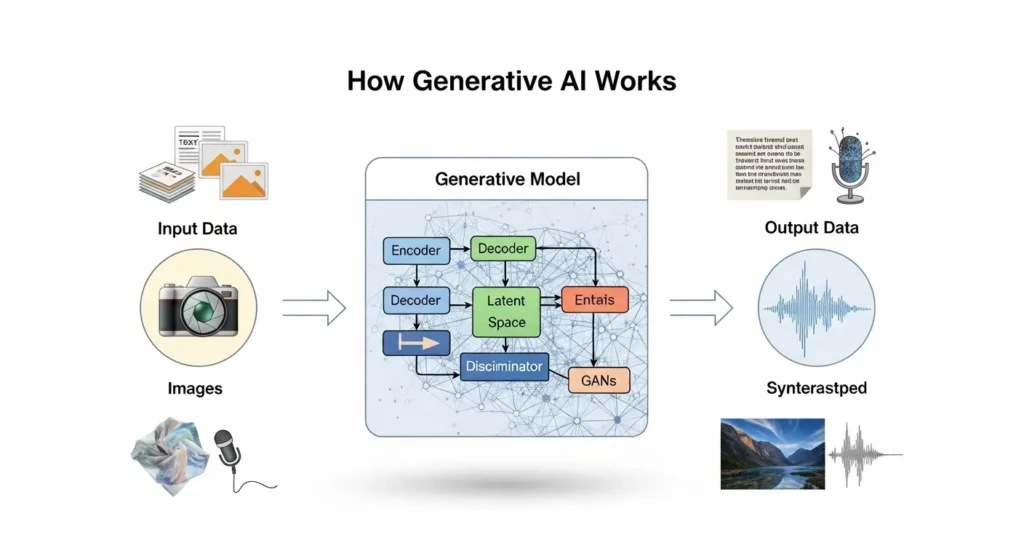
How Generative AI Works
In 2026, businesses will increasingly rely on generative AI. In part, this is because numerous businesses, creative professionals and software developers use generative AI for quicker and less-expensive ways of generating content. Here are some of the main reasons why generative AIs will be important in 2026:
- Content generation time will be reduced.
- Worker productivity will be improved.
- Personalization will be out of reach for many companies.
- Worker dependency on manual effort will decrease.
It’s clear that, by the year 2026, generative AI will become a central component of every company’s digital transformation strategy.
Why This Technology Matters in 2026
By 2026, businesses and creators rely heavily on AI-powered content generation to stay competitive. The demand for personalization, rapid production, and digital scalability has made this technology essential.
Key Reasons It Matters:
Accelerates content production
Reduces operational costs
Enables personalization at scale
Improves workflow efficiency
Supports rapid innovation
This shift marks a major milestone in digital transformation strategies worldwide.
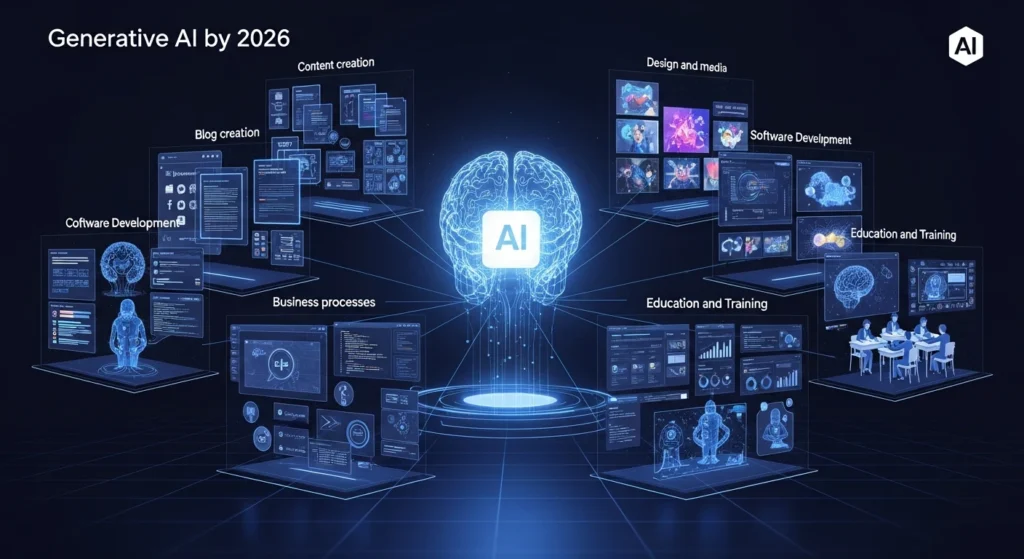
Key Applications of Generative AI in 2026
1. AI-Powered Content Creation
Content marketing has changed dramatically. AI writing tools now assist with:
Blog articles
Ad copy
Social media captions
Video scripts
Email campaigns
Instead of spending hours drafting content manually, creators can refine and optimize AI-generated drafts quickly.
Related Terms: AI writing tools, automated content creation, digital publishing automation
2.Design and Creative Media
Designers utilizing generative AI to:
- To be able to develop images and illustrations.
- To be able to create visual representations for video.
- To develop a company’s brand identity
- To try new ideas in the design process.
Generative AI will increase creativity, and not take away from it, as we move into the future.
3. Software Development and Coding
Developers benefit significantly from AI-assisted coding platforms. These tools help:
Generate code snippets
Detect bugs
Suggest optimizations
Create technical documentation
This dramatically reduces development time and increases productivity.
4. Business and Workflow Automation
Businesses are utilizing generative AI to automate parts of their processes such as:
- Customer Communication.
- Sales Messages.
- Product Descriptions.
- Internal/Employee Documentation.
Generative AI combined with automation systems will create an effective method to improve business processes.
5. Education and Personalized Learning
Starting in 2026 educational institutions will utilize generative AI to:
- Create individual Courses for Students.
- Create Quizzes and examinations for each student.
- Create personal student learning paths based on student achievement at work.
Advantages and Disadvantages of Generative AI
Generative AI is helping both organizations and individuals in many ways.
Advantages
- Fast creation of content.
- Decreased costs for both operating a business and delivering services.
- Increased ability to create new and innovative solutions.
- Greater ability to grow and scale without needing to hire more resources
- Enhanced customer experience through personalization.
Through using generative AI effectively, individuals are able to accomplish more while using less.
Disadvantages
Generative AI’s many benefits are accompanied by challenges that need to be resolved in a thoughtful manner – such as:
- Privacy of data (your data must be protected).
- Accuracy and misinformation generated by AI.
- Fairness of AI models and learning.
- Ownership issues with respect to intellectual property.
By 2026, the implementation of helpful ethical principles and governance will be instrumental in providing for responsible implementation of generative AI solutions.
Future Outlook Beyond 2026
Going forward, Generative AI will:
- Gain autonomy.
- Become integrated within all aspects of daily life through enhanced technology.
- Allow for instantaneous content development by writing on-demand as quickly as you can type informa-tionapsfrom all of your sources.
Enhance human creativity on a much larger scale as there will be unlimited ways to col-laborate inn the sharing of ideas.
Conclusion
In 2026, Generative AI stands at the center of technological evolution. It is transforming how businesses operate, how developers build applications, and how creators produce content. Instead of replacing human creativity, it enhances efficiency and unlocks new possibilities.
The future belongs to individuals and organizations that embrace this innovation responsibly. With proper governance and ethical standards, generative systems will continue to redefine digital creativity and productivity in the years ahead.
Frequently Asked Questions (Faqs)
Q1.Why is generative AI so vital in 2026?
Generative AI contributes to increased productivity, reduced manual labour, and creativity across many industries including marketing, design, education, and software development.
Q2.Is it safe to use generative AI?
Yes, provided it is used appropriately while complying with established data privacy and ethical norms with the supervision of a human being.
Q3.Can generative AI take over human creativity?
No; generative AI improves creativity by complementing human beings, rather than eliminating them.
Q4. What industries benefit greatly from generative AI?
Marketing, media, education, software development, healthcare, and e-commerce reap significant results from generative AI.