
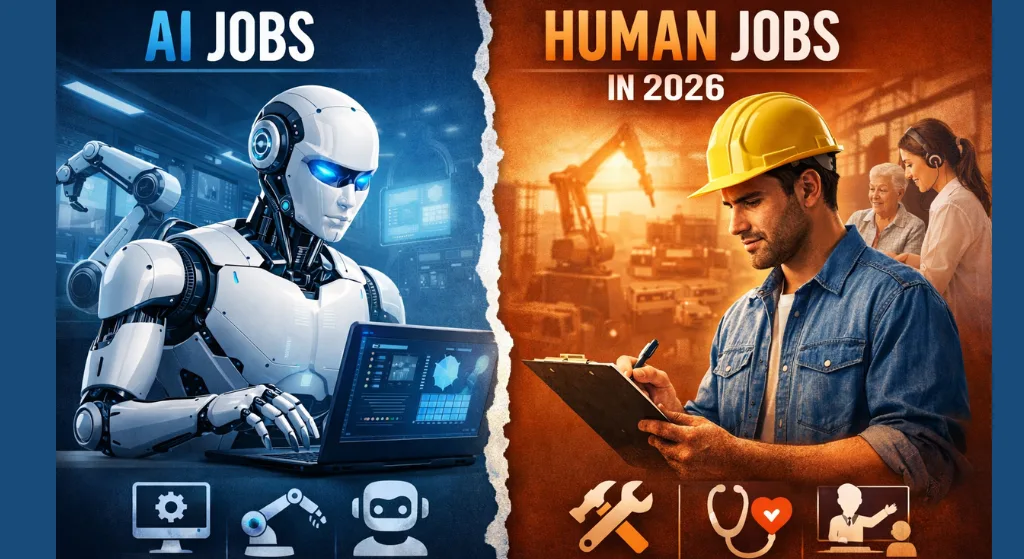
AI vs Human Jobs in 2026: What Will Change and What Will Not
The world has never seen a technology transition take place as rapidly as the impact that AI is having on the global workforce today. One of the major debates you’re likely to hear in 2026 will be: Is AI jobs 2026 replacing human jobs or creating new ones? The truth behind AI jobs in 2026 will prove to be much more complicated and blended than the sensational headlines we read regarding AI killing jobs suggest.
AI isn’t just taking away jobs; it’s transforming how people do their jobs, how people and machines work together, and creating new skill sets. You’ll learn in this article what will change with regards to AI in 2026, and what will remain unchanged, as well as how AI jobs in 2026 will be affecting the employees that fill the positions, the companies that employ them, and the overall future of employment.
Understanding AI Jobs in 2026
The term AI jobs 2026 refers to the impact of artificial intelligence on employment trends, workforce transformation, and job creation by the year 2026. AI systems are becoming more capable of handling repetitive and data-heavy tasks, but they still rely on human creativity, judgment, and emotional intelligence..
Consequently, rather than Completely replace jobs, AI is driving the evolution of jobs.
Why AI Is Changing Jobs Faster Than Ever
Several factors are accelerating the rise of AI in the workplace:
- Rapid advancement in machine learning.
- Affordable AI automation tools.
- Increased data availability.
- Demand for efficiency and scalability.
These factors are shaping the reality of AI jobs 2026, especially in industries reliant on routine processes.
Why AI Jobs 2026 Are Changing Rapidly
Several factors are accelerating the shift in AI jobs 2026:
Rapid advancements in machine learning and deep learning
Affordable AI-powered automation tools
Increased data availability across industries
Rising demand for efficiency and productivity
These trends are pushing companies to rethink workforce structures. As a result, AI jobs 2026 are centered around automation of tasks—not elimination of human contribution.
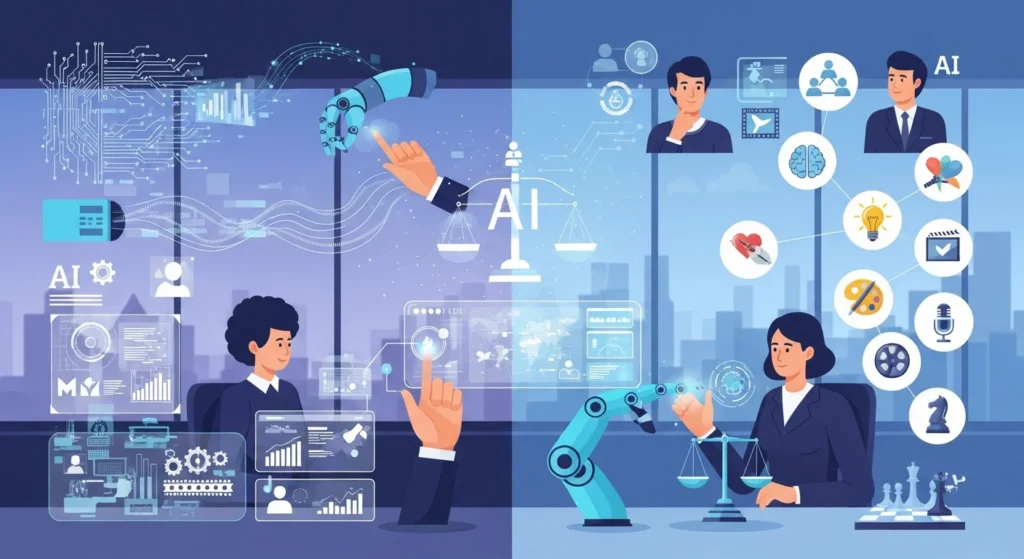
Jobs Most Likely to Change Due to AI
1. Repetitive and Process-Based Jobs
AI’s ability to execute repetitive tasks is superior; therefore, roles that rely predominantly on preset workflows have been substantially affected.
The following are examples:
- Data entry clerks.
- First level customer service representatives.
- Simple accounting positions.
In 2026, positions that have traditionally relied on human resources will have transitioned to being largely automated through the use of AI, enabling people to work on higher-value tasks.
2. Manufacturing and Operations
There is a revolution occurring within the manufacturing sector through the introduction of AI-powered robot systems and predictive technologies to help improve manufacturing processes.
Examples of this change include:
- Automating quality checks.
- Predicting when machinery requires maintenance.
- Optimizing supply chains.
While there will be fewer manual operational activities, more technical and supervisory jobs will be created.
3. Administrative and Clerical Functions
AI technology is allowing the automation of many of the administrative tasks associated with managing scheduling, documentation and reporting, thus:
- Administrative employees will spend less time actually performing manual tasks.
- Administrative employees will spend more time coordinating and making decisions.
This shift towards robotically automating most functions is one of the major trends identified by the AI Jobs Report of 2026.
Jobs That Will Grow in AI Jobs 2026
1. AI and Technology Roles
Demand is rapidly increasing for:
AI engineers
Machine learning specialists
Data scientists
AI product managers
Automation consultants
These positions define the expansion side of AI jobs 2026 and are expected to grow significantly.
2.Human-Centered Professions
Jobs that require empathy, leadership, and creativity remain difficult to automate.
Examples include:
Healthcare professionals
Teachers and educators
Therapists and counselors
Business leaders and strategists
AI jobs 2026 emphasize that emotional intelligence and human connection cannot be replaced by algorithms.
3. Hybrid AI-Integrated Roles
One of the biggest outcomes of AI jobs 2026 is the rise of hybrid careers combining domain expertise with AI literacy.
Examples include:
AI-assisted marketers
Automation managers
Prompt engineers
AI workflow analysts
These hybrid roles demonstrate how AI jobs 2026 focus on collaboration between humans and machines.
What Will Not Change in 2026
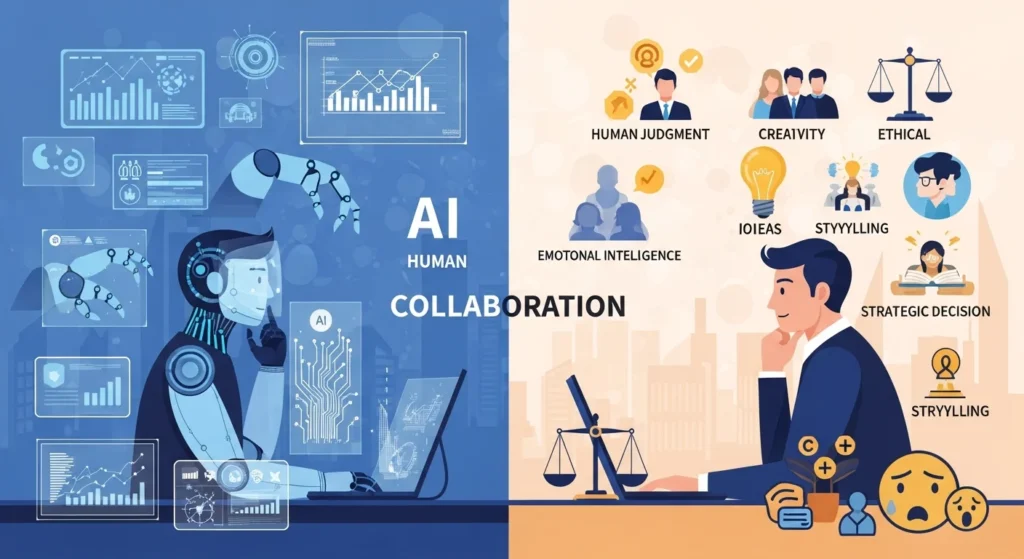
Despite rapid automation, certain core elements of work will remain unchanged:
Human judgment and ethical reasoning
Strategic thinking and innovation
Creativity and storytelling
Leadership and vision
AI supports decision-making but cannot replicate human intuition. This balance defines the long-term outlook of AI jobs 2026.
How Businesses Are Adapting to AI Work in 2026
Organizations are redesigning operations to prepare for AI jobs 2026. Key strategies include:
Upskilling and reskilling employees
Investing in AI training programs
Redefining job roles
Encouraging human-AI collaboration
Companies that proactively adapt to AI jobs 2026 are more likely to remain competitive and sustainable.
Ethical and Social Impact of AI on Jobs
The expansion of AI jobs 2026 also raises concerns:
Workforce displacement risks
Skills gap between workers
Bias in AI hiring tools
Economic inequality
Governments and businesses must ensure responsible AI deployment with fair workforce policies.
Conclusion
The discussion around AI jobs 2026 often focuses on fear of job loss. However, the real story is evolution, not elimination. Artificial intelligence will automate repetitive tasks, improve efficiency, and create entirely new job categories.
Human creativity, empathy, and strategic thinking remain irreplaceable. Professionals and organizations that adapt to AI jobs 2026 by upskilling and embracing collaboration will thrive in the modern workforce. The future belongs to those who learn how to work alongside intelligent machines rather than compete with them.
Frequently Asked Questions (Faqs)
Q1.What are AI jobs 2026?
AI Jobs 2026 refers to the changes artificial intelligence will create in regards to jobs; job automation, the evolution of existing jobs, and the creation of new jobs will all happen by 2026.
Q2.Will artificial intelligence replace human beings?
AI will automate tasks but will not replace entire jobs, and most positions will transition to new duties/roles instead of being eliminated altogether.
Q3. What jobs are least likely to be replaced by AI?
Careers or duties that rely on creativity, emotional intelligence, leadership, and complex decision-making will be among those least likely to be replaced by computers.
Q4.What skills are critical to a person finding an AI job in 2026?
AI literacy, problem-solving skills, creativity, communication proficiency, and an adaptable attitude/ability are key skills when looking for an AI role in 2026.