
AI Training Trends in 2026: What to Learn & Why
In recent years, Artificial Intelligence (AI) has changed the way industries are run. In today’s world, whether you’re in healthcare, finance, marketing or education, one thing is certain: Having access to the latest AI training can make all the difference for professionals, students and businesses alike. To prepare yourself for what lies ahead in your career, you must embrace AI as it changes industries and provides new opportunities in 2026 and beyond. This guide will look at three major topics: What AI training trends will be popular in 2026; The skills required to benefit from AI training, and Why it will be advantageous for you in 2026 and beyond.
There are many reasons why AI Training is now considered necessary and valuable, including:
AI has moved well beyond just a niche technology and is rapidly becoming mainstream technology throughout all sectors and industries. The primary reasons for this transformation include:
- Career Advancement – One of the highest-paying skill sets across the tech industry continues to be proficiency with artificial intelligence tools.
- Business Benefits – AI-educated professionals enable businesses to leverage smarter, innovative solutions for data analysis, automation of business processes, and predictive analytics.
- Future Employment Preparation – AI will be an important component of emerging technologies such as robotics, self-driving vehicles, and generative AI.
Why AI Training Matters in 2026
Artificial Intelligence is no longer limited to research labs. Today, businesses of all sizes are using AI tools to automate processes, enhance customer experiences, and make smarter decisions. AI training provides you with:
Practical AI skills employers want
Hands-on experience with AI tools
Knowledge of industry applications
Competitive advantage in the job market
👉 For more on how to choose the right programs, see our guide on Top AI Courses in 2026.
Top AI Training Trends in 2026
1. Generative AI Training Takes Center Stage
Generative AI has impacted many creative and functional industries by providing extraordinary results through tools like ChatGPT and DALL-E. The vast majority of the AI training programs conducted throughout 2026 have focused on providing hands-on experience using “real” generative tools, allowing trainees to apply what they have been exposed to in practice.
Key Skills to Acquire Through Generative AI:
- NLP (Natural Language Processing).
- Generating Content Through AI.
- The Engineering of Prompts.
- Utilizing AI to Create and Design Workflows.
2. AI Training in Automation and Robotics
Automation is one of the major driving forces behind the increasing efficiency of many processes. When you can automate repetitive tasks through the use of robots and robotics, you can significantly enhance the quality and performance of your systems. Through AI training in robotics and automation, trainees acquire the knowledge and skills required to design and build smarter automated systems with improved operational flows.
Key Skills to Acquire Through Automation and Robotics:
- Robotic Process Automation (RPA).
- Optimizing Workflows with AI.
- Designing Intelligent Systems.
3. Online and Miniature AI Courses
Increasingly, short courses using only online environments are becoming more and more accepted as viable training options. These types of courses allow trainees to learn about specific AI topics or skills without committing to long-term training programs to obtain a broader set of knowledge.
Common AI Training Platforms include:
- Coursera AI training.
- Udemy AI training.
- LinkedIn Learning AI training.
4. AI Certification Programs
AI Certification provides credibility and demonstrates that an individual possesses the necessary skills to be potentially ready to perform competitively in today’s workforce.
Popular AI Certificates to Explore:
- Microsoft Certifications in AI Engineering.
- Google AI Engineer Cert.
- IBM AI professional certificate.
5. Industry-Specific AI Training
Specialized artificial intelligence (AI) training programs based on industry sectors, such as healthcare and finance, have been gaining popularity. These programs provide a complete understanding of applying AI techniques in real-world scenarios rather than just theoretical knowledge.
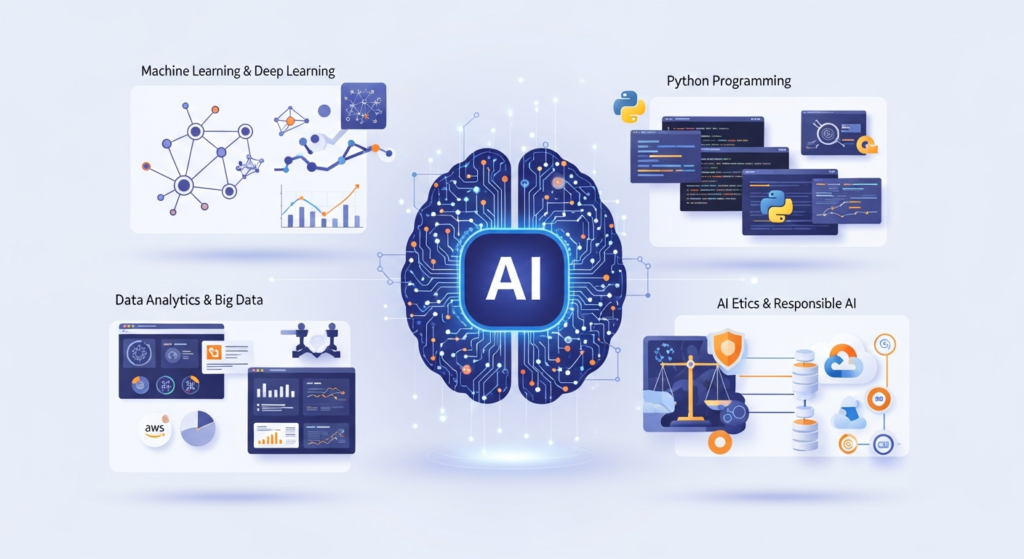
Skills You Must Learn in AI Training
Whether you’re a beginner or experienced professional, these skills are essential:
Python Programming for AI
Natural Language Processing (NLP)
Data Analytics & Big Data
AI Ethics & Responsible AI
Cloud-based AI Tools
AI training that covers these areas will prepare you for future jobs and real-world projects.
👩💼 Who Should Pursue AI Training?
AI training is relevant for a wide range of learners:
Students & fresh graduates
Working professionals
Business owners & leaders
IT teams & developers
Sales & marketing professionals
If your goal is career growth or digital transformation, AI training can be a game-changer.
There are five important skills
- Machine Learning and Deep Learning—Both are critical to the predictive analytics and AI solution process.
- Python Programming—Most AI tools on the market use the Python programming language to build and run AI systems.
- Data Analytics and Big Data—Needs data analytics expertise for working with large amounts of data.
- AI Ethics and Responsible AI—Deep understanding of bias and ensuring fairness through AI system use.
- Cloud AI Tools—Availability of cloud-based AI tools from AWS, Azure, and Google Cloud.
How to Choose the Right AI Training
- Check the Course Curriculum: Must cover practical AI tools, ML, NLP, and industry applications.
- Look for Certifications: A recognized certification boosts career prospects.
- Hands-On Learning: Projects, case studies, and real AI tools experience are critical.
- Mentorship & Support: Interaction with AI experts enhances understanding.
Conclusion
AI training in 2026 is essential for anyone looking to grow in the digital and tech economy. With the right skills, real-world projects, and certifications, you can unlock exciting career opportunities and stay ahead of the curve.
Start your AI training journey today and build the skills that matter.
Frequently Asked Questions (Faqs)
Q1.What's a good AI introductory course?
For beginners, it’s best to take a course on Coursera, Udemy, or LinkedIn Learning that features experiential projects. You should also gain an understanding of some basic skills in Python, machine learning, and natural language processing.
Q2.Do I need previous programming experience to take an AI course?
You should have at least a little previous programming experience (ideally, in the Python language), however many introductory courses will walk you through everything you need to know step by step.
Q3.How long will it take to complete an AI training course?
Short online courses (from resources such as Coursera, Udemy, etc.) typically take between 1 and 3 months to complete, while longer certificate or certification courses may take anywhere from 6 months to a year.
Q4.Is AI training worth it if I want to move up in my career?
AI skills are in high demand and therefore if you complete a program and become certified, you will likely command higher salaries than non-certified individuals.
3 thoughts on “AI Training Trends in 2026: What to Learn & Why”