
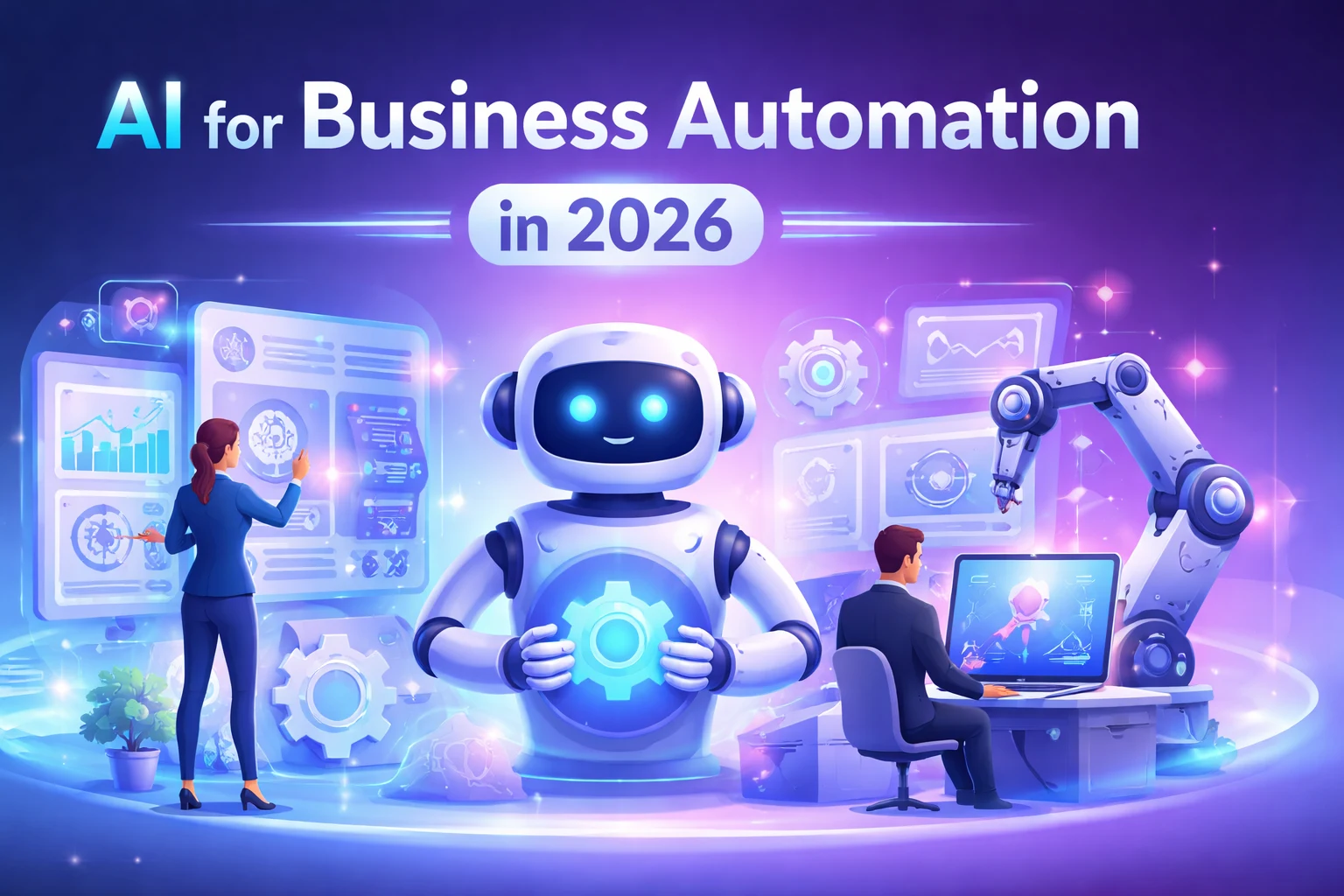
Introduction: AI for Business Automation in 2026
In the year 2026, many organizations are no longer debating if they should utilize artificial intelligence, but now they are focused on how quickly they can implement it into day-to-day business operations. One of the most impactful forces behind the digital transformation of businesses will be AI for the automation of their business. Companies across all industries are beginning to implement AI-based systems in order to improve their workflows and minimize operational costs, as well as enhance their overall efficiency.
AI for automation of businesses is completely changing how businesses operate today. Companies are using AI for the automation of their business processes by having their businesses develop adaptive, scalable, and self-learning systems that will “continuously optimize” the performance of their business, rather than just using AI to eliminate repetitive manual tasks. This change in the way that AI for business automation is developing is representing a shift away from traditional automation towards intelligent automation to help drive long-term growth and innovative ideas.
What Is AI for Business Automation?
AI for business automation is defined as the intelligent use of ai technologies (machine learning, natural language processing, and predictive analytics) to automate a company’s business processes. This is different than traditional automation that uses fixed rules to automate a process. AI for automation of businesses can:
- Learn from data.
- Adapt to new situations.
- Make data-driven decisions.
- Continuously optimize workflows.
The movement to intelligent automation instead of rule-based automation is going to impact how automation develops within the business world going forward.
What Is AI for Business Automation?
According to a study from McKinsey & Company and the World Economic Forum AI automation has been shown to significantly increase global productivity.
Factors for the rapid growth rate of AI usage:
- Increased operating costs.
- Data complexity is increasing exponentially.
- Companies require real-time data insight.
- Need to create scalable systems.
- Increased competition.
By utilising AI for business automation, companies can gain an advantage in how quickly, accurately and cost-effectively they deliver goods/service
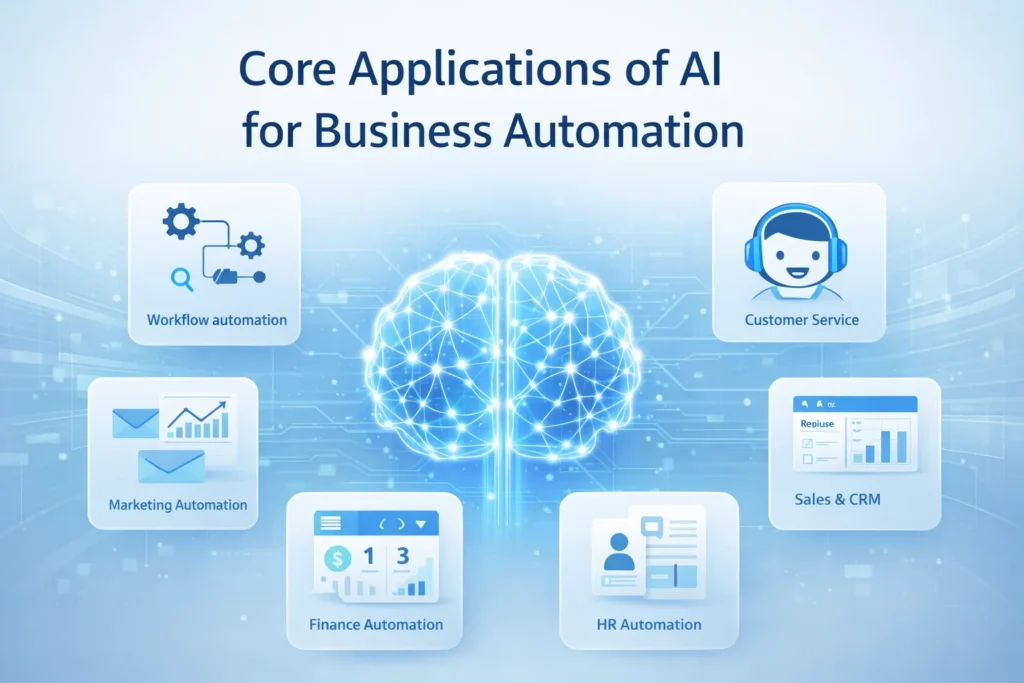
Core Applications of AI for Business Automation
1. Automation of Workflows
Many businesses use AI for automation to streamline workflows and processes. AI allows for workflow automation software to manage multiple aspects of the workflow without human intervention. With the capability to automate workflows, AI can:
Assign tasks automatically
- Identify bottlenecks.
- Prioritize high-impact work.
- Optimize resource allocation.
Rather than coordinating tasks manually, AI manages all of the business workflow processes through intelligent systems.
2. Customer Service Automation
The use of chatbots and virtual assistants powered by AI has dramatically changed the way that companies provide customer service. AI can automate aspects of a customer’s service experience by providing 24/7 access, can analyze customer needs and intent to provide more relevant responses, and can reduce the operating costs of providing customer service. Many large organizations are working with companies like IBM to create intelligent customer service systems.
3. Automated Marketing
Marketing departments are accelerating their investment in AI to automate aspects of marketing campaigns to improve effectiveness. AI can help automate marketing efforts by:
- Creating personalized email campaigns.
- Predicting customer behaviour to establish targeting parameters.
- Automating optimization of digital advertisements.
- Providing content recommendations.
When used effectively, AI will provide better ROI and can support data-driven marketing efforts.
4. Sales & CRM Automation
Sales teams are using automation to create greater productivity and efficiencies in their sales by using AI to:
- Automatically score leads.
- Predict the likelihood of a conversion.
- Recommend next steps to take with leads.
- Automatically update CRM records.
As a result, AI automation will give sales professionals more time to focus on relationship building and less time on non-value added activities such as data entry.
5. Financial & Accounting Automation
AI has made significant advances in automating the following processes in finance and accounting:
Processing invoices
- Detecting fraud.
- Forecasting revenue and expenses.
- Categorizing expenses.
As companies leverage AI to automate their accounts payable and receivable processes, they will have significantly reduced error rates, as well as be assured of regulatory compliance while continuing to provide accurate financial reporting.
6. HR and Talent Management Automation
Human resources departments use AI automation tools for:
- Resume screening.
- Interview scheduling.
- Performance analysis.
- Attrition prediction.
This allows HR teams to focus on strategic workforce planning instead of manual administrative work.
AI for Business Automation Key Benefits
Organizations that use ai for business automation have measurable benefits:
Increase Productivity
Automation of manual and repetitive tasks will lead to increased productivity through faster processing times.
Reduce Costs
Operational costs will be reduced as there are fewer employees manually doing work.
Improve Decision-Making
Timely analytics provided by ai will result in improved decision-making through access to more accurate data.
Increase Scalability of Business Operations
An organization can grow its operations without an equivalent increase in the size of its workforce.
Improve Customer Service Experience
Providing quicker responses and having a personalized response will enhance the overall customer experience.
These illustrate why ai usage in business automation is a central element of an overall enterprise strategy.
Challenges of AI for Business Automation
Business Automation Using AI Presently has Advantages, But Business Must Address the Following:
- Data Privacy Concerns.
- Integration Complexity.
- Algorithm Bias.
Over Dependence on Automation
How Businesses Can Successfully Implement AI for Business Automation
Gartner advises businesses to have a balanced approach between automation and humans in order to implement ethical uses of AI.
The keys to achieve success are:
- Identify high impact processes and start the automation effort there.
- Invest in employee training.
- Utilize automation software that has a proven track record of reliability.
- Develop and implement strong cybersecurity measures.
- Continuously monitor and improve automated processes.
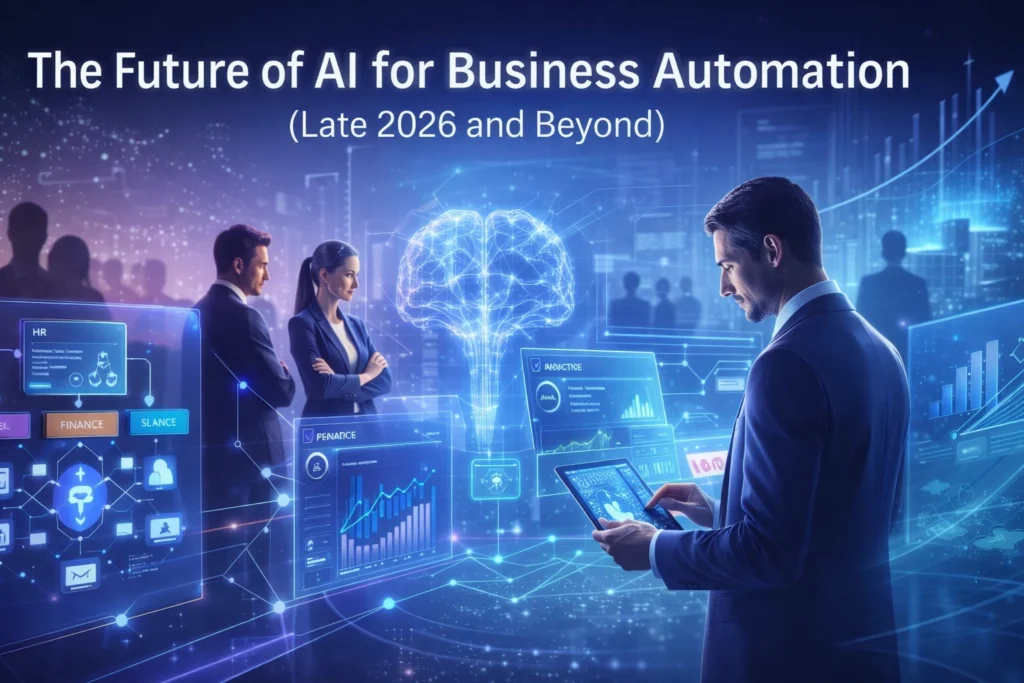
The Future of AI for Business Automation
AI for Business Automation Needs A Strategic Approach and a Deliberate Plan, Not an Unplanned Approach.
Late 2026 and beyond:
- AI systems will become more autonomous.
- There will be an increase in cross-departmental automation of processes.
- Predictive decision making will be the norm.
- Human-AI collaboration will be standard.
AI will not result in the elimination of Leadership Positions but rather help them do their jobs better by empowering them with tools that make it easier to lead.
Conclusion
In 2026, AI will no longer be a luxury item or an experimental investment; it is a necessity for sustainable growth. Companies that implement intelligent automation systems experience quantifiable increases in efficiency, scalability, and attractiveness as a long-term competitor. As the world becomes increasingly data-driven and fast-moving, AI for business automation allows organizations to react quickly to change, decrease operational bottlenecks, and provide customers with better experiences.
Through the use of modern workflow automation software, advanced AI technologies, and robotic process automation (RPA) solutions, many companies are transforming traditional business functions (e.g., finance, marketing, human resources, and supply chain management) into automated processes. The most significant value delivered by AI for business automation is not the elimination of human labor but rather the enhancement of human labor. By combining human creativity and decision-making capabilities with intelligent automation, businesses can create a powerful hybrid productivity model.
Organizations that invest in employee reskilling, adoption of responsible AI, and strategic integration will lead the next wave of digital transformation. AI for business automation does not eliminate jobs; instead, it reimagines jobs and enables teams to focus on innovation, strategy, and high-value tasks.
Frequently Asked Questions (Faqs)
Q1. What exactly does AI for business automation entail?
AI for business automation employs technological advances in artificial intelligence in order to automate business workflows, improve operational efficiency, and provide better decision-making capabilities within a business.
Q2.How does AI for business automation differ from traditional automation?
Traditional automation uses established rules for decision-making; however, AI for business automation will analyze the available data to determine the best way forward in the future.
Q3. Which industries see the greatest gains by using AI for business automation?
The healthcare, banking/financial services, retail, manufacturing, and eCommerce industries have the largest opportunity for improvement using intelligent automation today.
Q4.Are small businesses able to use AI for business automation?
Absolutely! Many of today’s AI-based automation solutions are affordable and scalable enough for small and medium businesses to utilize.